


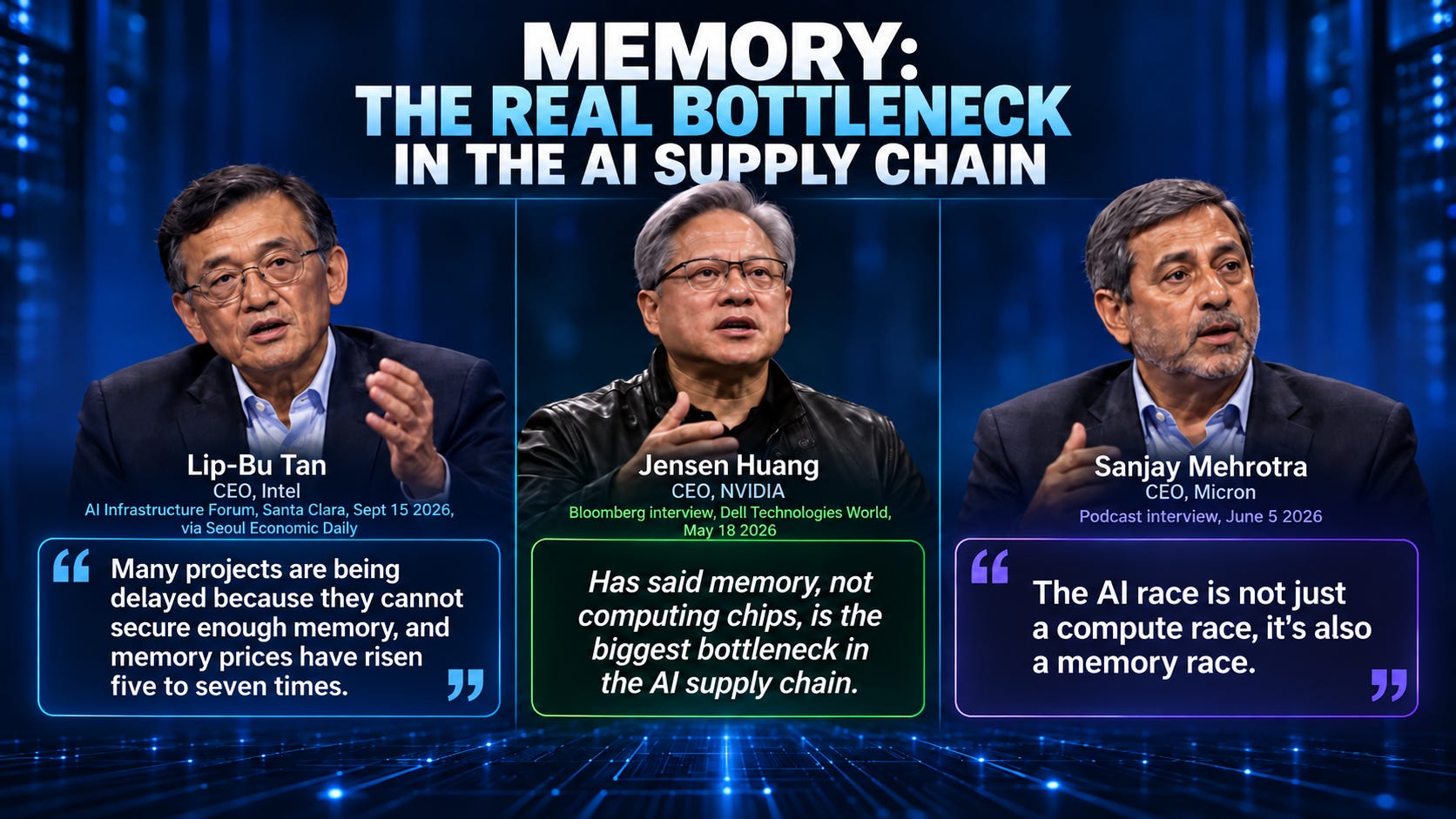
At the AI Infrastructure Forum in Santa Clara on September 15, Intel CEO Lip-Bu Tan was asked what problem he wanted AI infrastructure founders to solve.
His answer was memory.
“It actually happened, and the situation will get worse.”
Tan said capacity is limited, projects are being delayed, and memory prices have risen five to seven times.
NVIDIA CEO Jensen Huang has made the same point from the buyer side.
He has said memory, not GPUs or AI accelerators, is now the biggest constraint in the AI supply chain, with Michael Dell agreeing on stage.
Micron CEO Sanjay Mehrotra put the thesis in one line:
“The AI race is not just a compute race, it’s also a memory race.”
A GPU is like the world’s fastest factory. Memory is the warehouse feeding it.
If memory cannot deliver data fast enough, expensive GPUs sit waiting.
That is the bottleneck.
That is why memory is becoming one of the most important parts of the AI buildout.
How Memory Evolved With AI
The memory story gets easier when you follow how computing changed.
Era 1: CPUs + DRAM
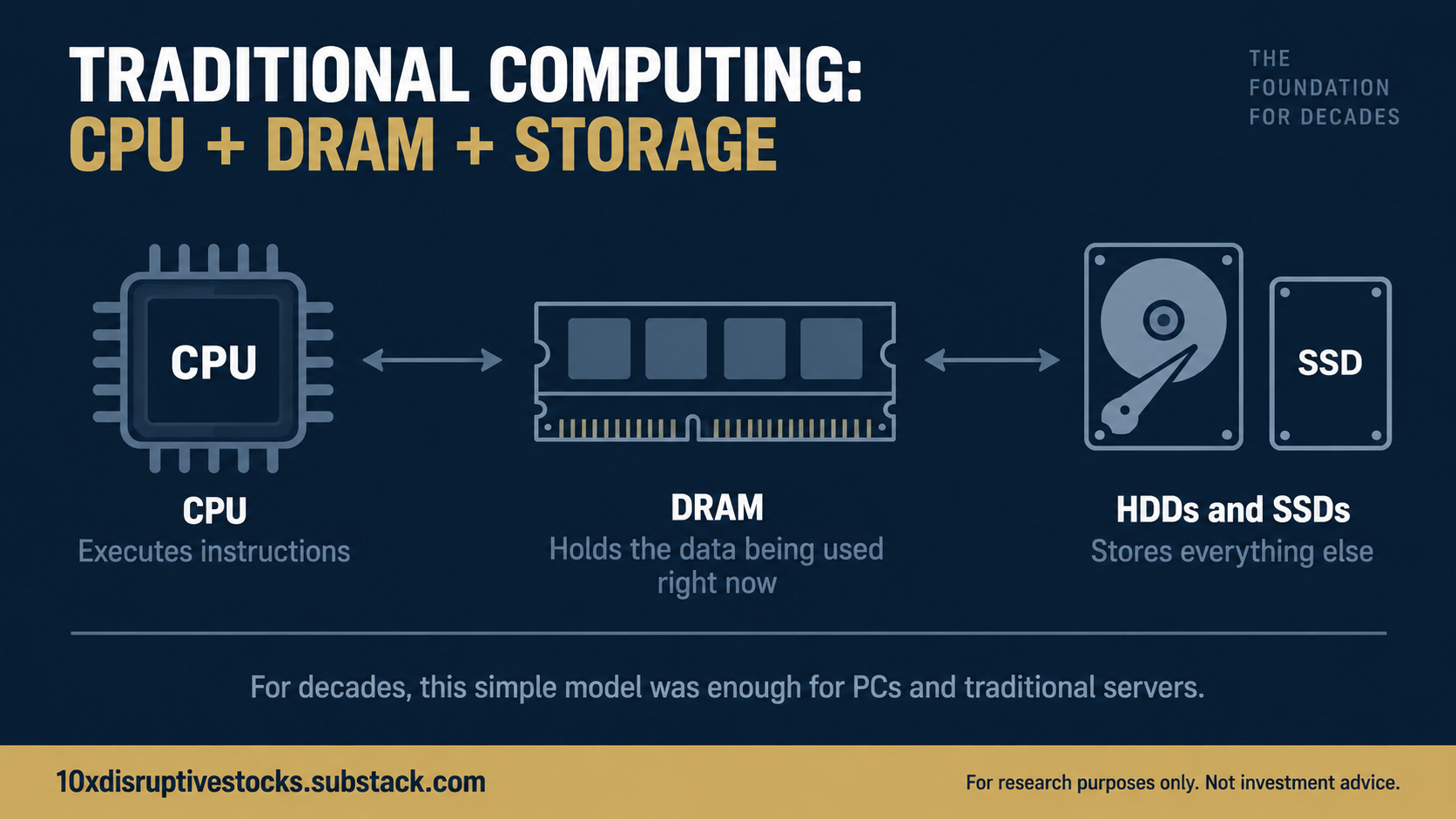
For decades, most computers worked like this:
CPU → DRAM → Storage
The CPU did the calculations.
DRAM held the information being used right now.
Hard drives, and later SSDs, stored everything else.
That architecture worked for PCs, servers and traditional software.
Then AI arrived.
Era 2: GPUs Created the HBM Boom
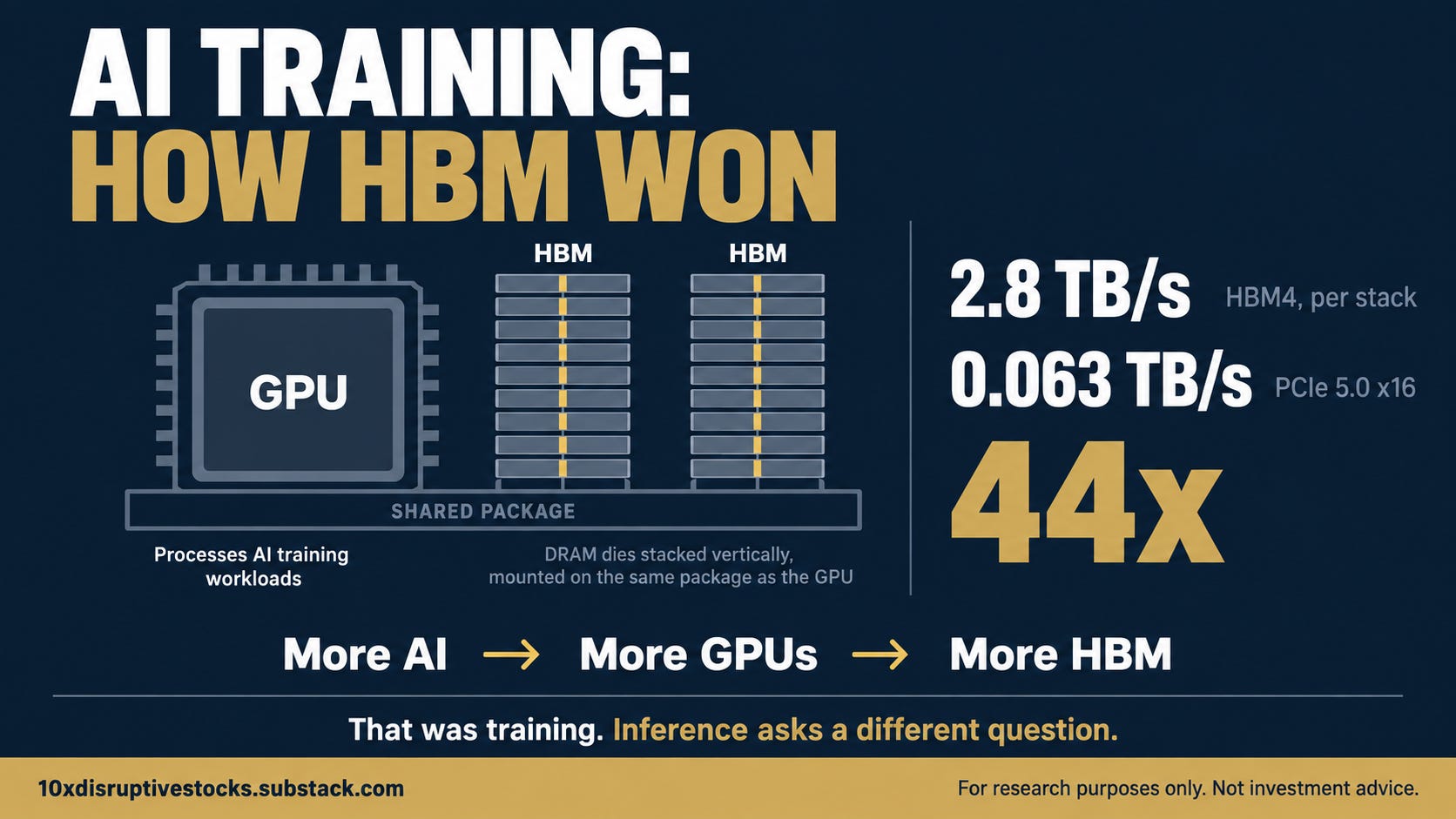
GPUs can perform far more calculations in parallel than CPUs, which made them ideal for training AI models.
But GPUs could process data faster than traditional memory could feed them.
The solution was HBM, or High Bandwidth Memory.
HBM stacks DRAM vertically and places it close to the GPU, dramatically increasing how quickly data can reach the processor.
That created the first AI memory boom:
More AI → More GPUs → More HBM
But inference changes the problem.
Era 3: Inference Needs More Memory
Training teaches a model. Inference is what happens every time someone uses it.
Long conversations, AI agents and coding assistants need memory while the model generates an answer.
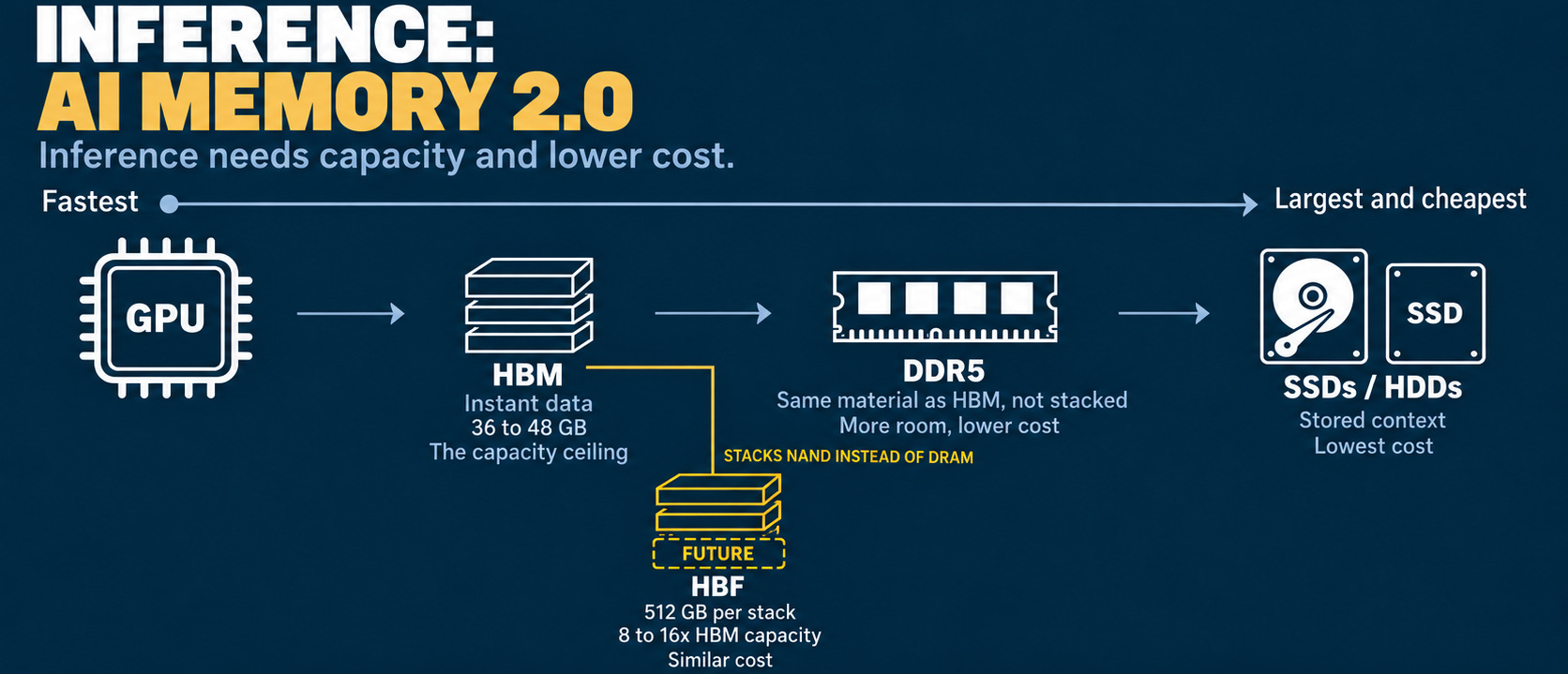
HBM handles the data the GPU needs immediately, but it is too expensive to hold everything.
So AI starts using different memory for different jobs:
HBM for the hottest data closest to the GPU.
DRAM for a larger pool of active working memory.
NAND and SSDs for cheaper stored data.
HBF for a potential new high-capacity layer closer to compute.
Keep the most important data in the fastest memory. Put everything else in larger, cheaper memory.
That is AI Memory 2.0.
What the Market Is Already Telling Us
The shift is already visible.
Conventional DRAM contract prices rose 93 to 98 percent in Q1 2026, followed by another 58 to 63 percent in Q2.
IDC expects smartphone shipments to fall 16.7 percent in 2026, largely because AI infrastructure is absorbing memory supply.
Micron also told investors that data-center NAND bit demand is accelerating because of AI use cases including vector databases and KV-cache offload.
That last point matters most.
Inference demand is already moving beyond HBM and into cheaper parts of the memory stack.
Two Materials Explain Most of the Stack
Memory comes down to two basic types.
DRAM is fast but temporary. Turn off the power and the data disappears.
NAND is slower but cheaper. Turn off the power and the data stays.
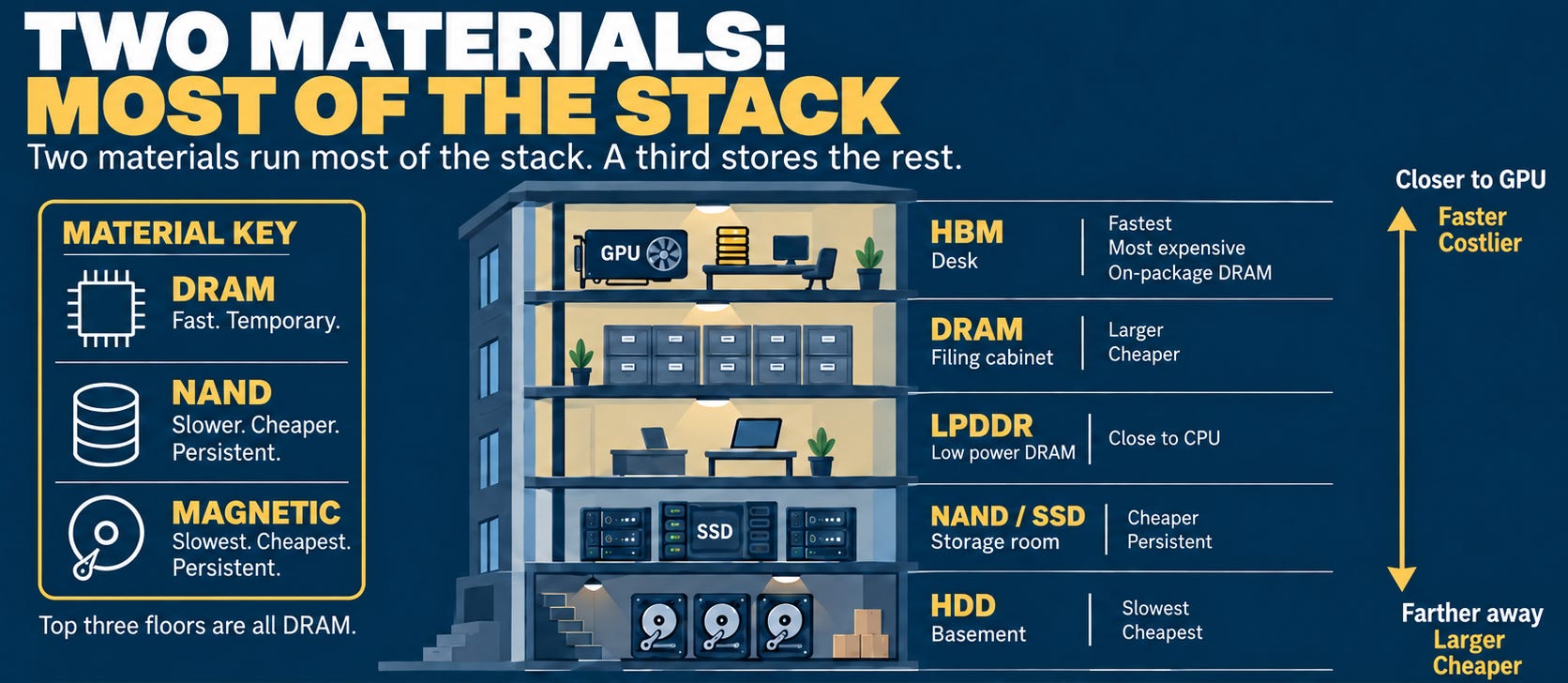
Think of AI memory like a building:
HBM is the desk. Stacked DRAM beside the GPU. Fastest and most expensive.
DRAM is the filing cabinet. More capacity at lower cost.
LPDDR is lower-power DRAM. SOCAMM is a way to package it close to the CPU.
NAND is the storage room. Cheaper, larger and permanent. SSDs use NAND.
HDD is the basement. Slowest, but cheapest for huge amounts of data.
Closer to the GPU means faster and more expensive. Farther away means larger and cheaper.
Where the Demand Is Coming From
Not every industry needs the same amount of memory.
The biggest demand is concentrated where AI does the most computing.
1. AI Data Centers

This is where memory matters most today.
A modern AI server needs:
HBM beside the GPU for maximum bandwidth.
DRAM for larger working-memory pools.
NAND and SSDs for models, databases, checkpoints and stored context.
Training created the first HBM boom.
Inference expands demand across the rest of the memory stack because every AI request needs memory while it runs.
That makes AI data centers the biggest driver of the current memory shortage.
2. Agentic AI

Agentic AI makes inference even more memory intensive.
A chatbot may answer one question.
An AI agent can work for much longer, read documents, use tools, write code and keep track of previous steps.
That requires more working memory, KV cache and storage for every task.
The longer AI works, the more information it needs to keep available.
This is why agentic AI could become the next major driver of server DRAM and storage demand.
3. Physical AI
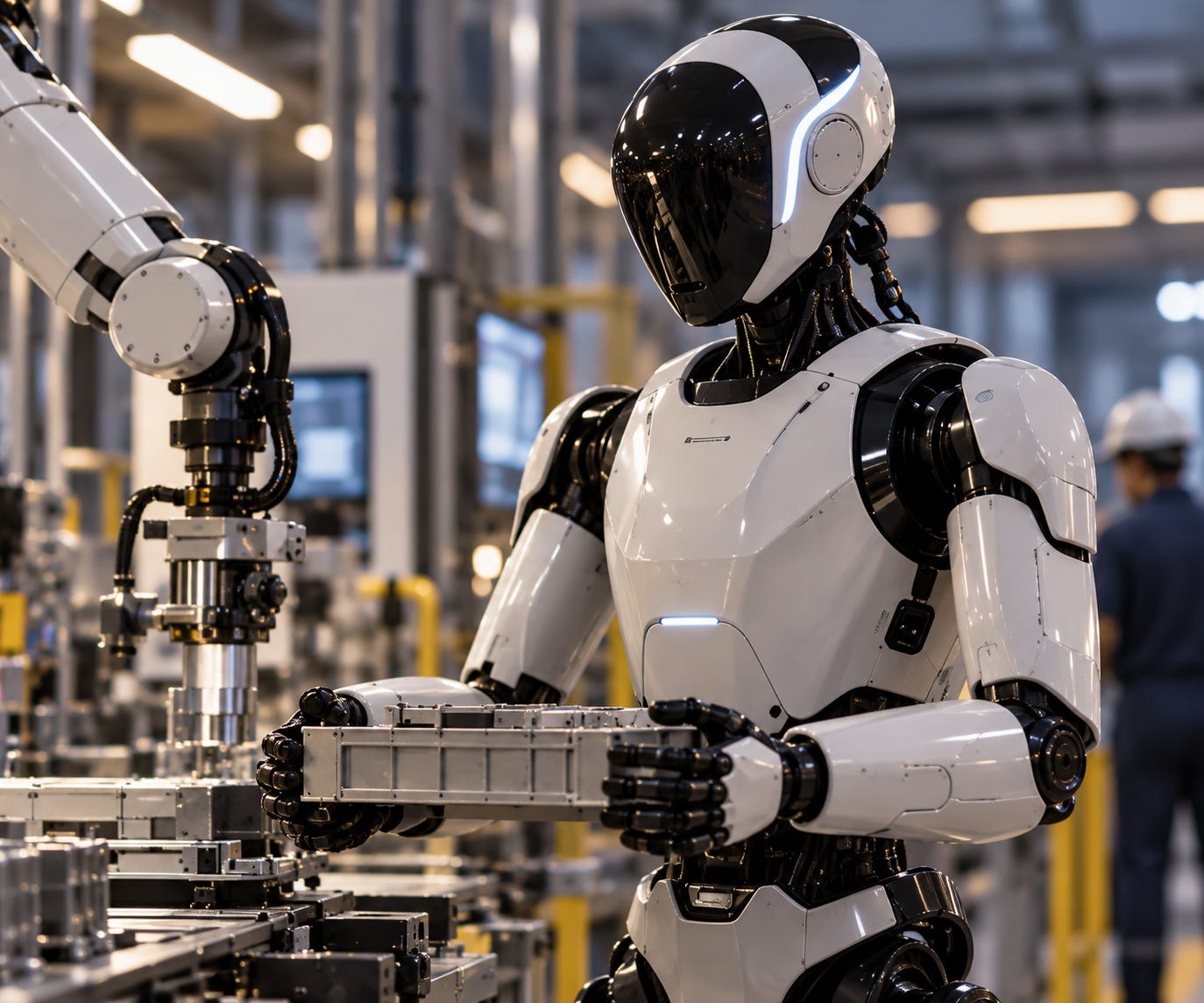
Physical AI could become the next large demand layer.
Humanoid robots, autonomous machines and intelligent equipment need memory locally for:
Models.
Vision and sensor data.
Maps.
Working memory.
Stored history.
That means LPDDR, DRAM, NAND and SSDs inside the machine.
Physical AI is not yet consuming memory at data-center scale, but millions of intelligent machines could eventually create another major source of demand.
Why Supply Cannot Catch Up Quickly
Demand can grow much faster than memory production.
Samsung, SK hynix and Micron control most of the DRAM market, while new capacity takes years to build.
HBM also uses much more wafer capacity per gigabyte than conventional DRAM.
AI demand is rising faster than the industry can add memory supply.
The AI Memory Ecosystem
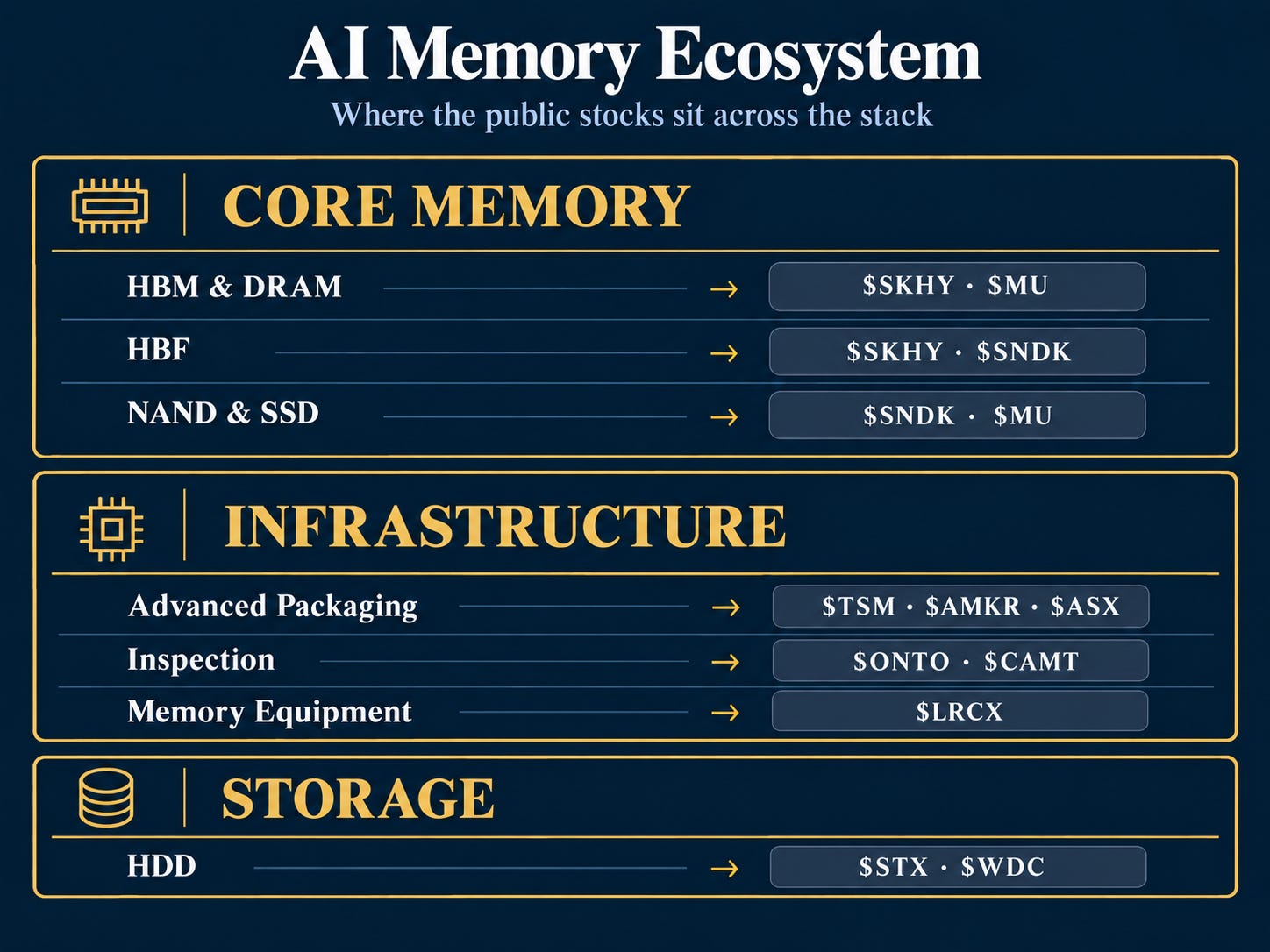
Where I See the Opportunity
The ecosystem is broad, but three stocks stand out to me:
Each gives exposure to a different part of AI Memory 2.0.
Below, I break down:
Why each stock matters
What could drive the next leg higher
The biggest risk to the thesis
Paid subscribers can continue below for the full breakdown of my three AI memory picks.