


Elon Musk Just Made an Extraordinary Prediction
On October 20, Elon Musk told investors that SpaceX could reach $500 billion to $1 trillion in annualized recurring revenue by the end of 2027.
Think about that.
A company that started by launching rockets is now talking about generating hundreds of billions of dollars annually.
That’s an enormous ambition, and it’s far above SpaceX’s current revenue and near-term guidance.
But here’s the part that caught my attention.
SpaceX isn’t really just a rocket company anymore.
Look at its latest quarterly results.
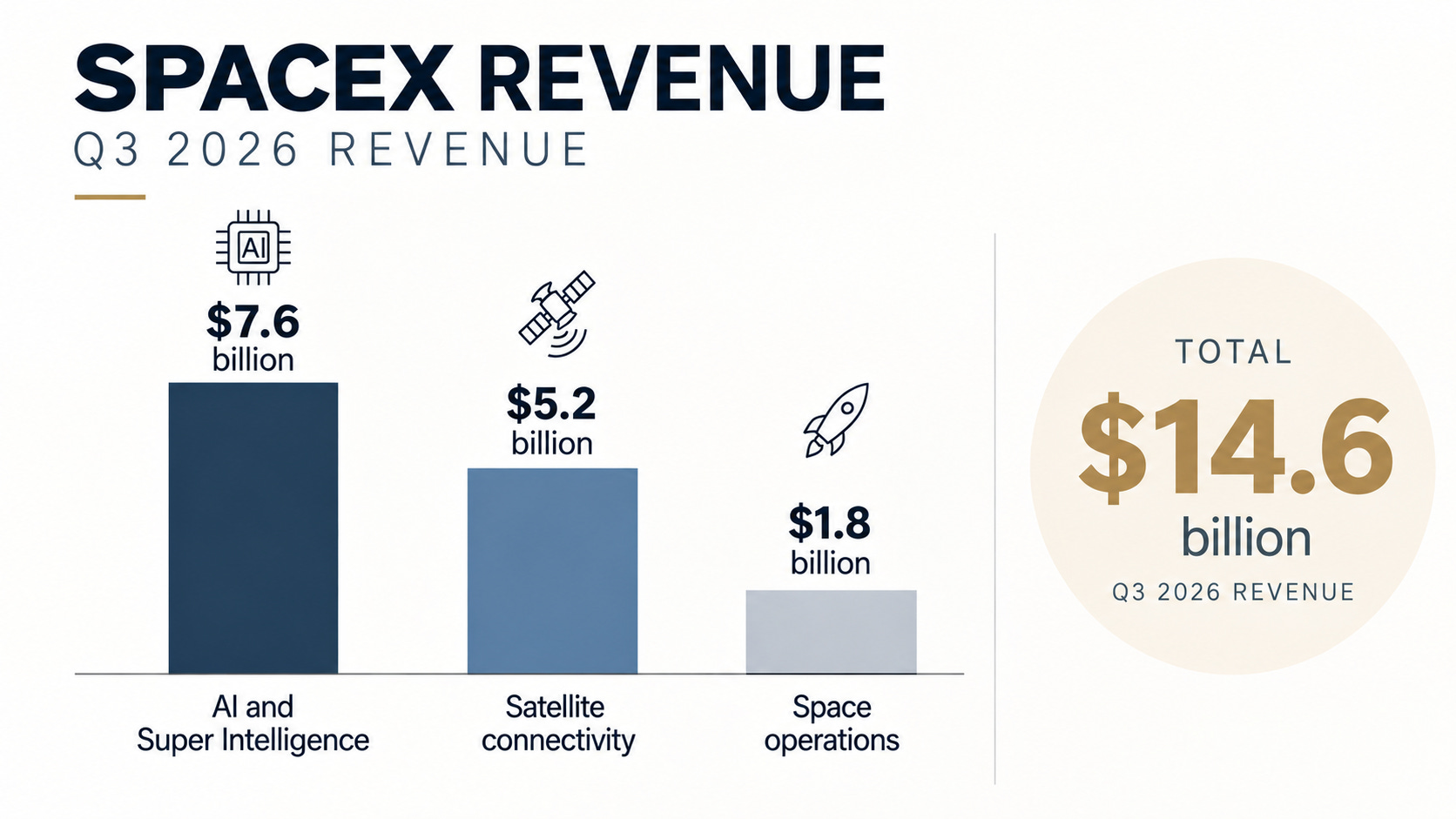
Only about 12% of reported revenue came from its traditional space segment.
The rest largely came from AI and connectivity.
That’s a remarkable transformation.
And it raises a question I think every space investor should ask:
What if the biggest money in space isn’t made from launching rockets, but from everything those rockets make possible?
That’s the real story I want to explore.
Because once you understand it, the entire space economy starts to look different.
And the companies that benefit might not be the obvious ones.
The 95% Cost Collapse That Changed Space
Getting to orbit used to be extremely expensive.
Space Shuttle: ~$54,500 per kilogram.
SpaceX Falcon 9: ~$2,700 per kilogram.
That’s approximately 95% lower, based on historical estimates using different cost measures.
Lower launch costs are making new businesses economically viable:
Satellite internet: Global broadband connectivity.
Earth observation: Agriculture, weather, and environmental monitoring.
Defense: Satellite surveillance and secure communications.
Space infrastructure: Satellites, components, and orbital services.
Space data: Commercial intelligence and analytics.
The investment opportunity extends beyond rocket manufacturers.
As launch costs decline, companies building satellites, connectivity networks, and space-based services gain access to larger markets.
Lower launch costs are an enabler. Recurring revenue, customer demand, and profitability will determine the long-term winners.
Space Could Follow the Internet’s Growth Model
The early internet required massive investment in infrastructure: cables, servers, and networks.
But many of the biggest winners emerged from services built on that infrastructure.
Google, Amazon, and Netflix.
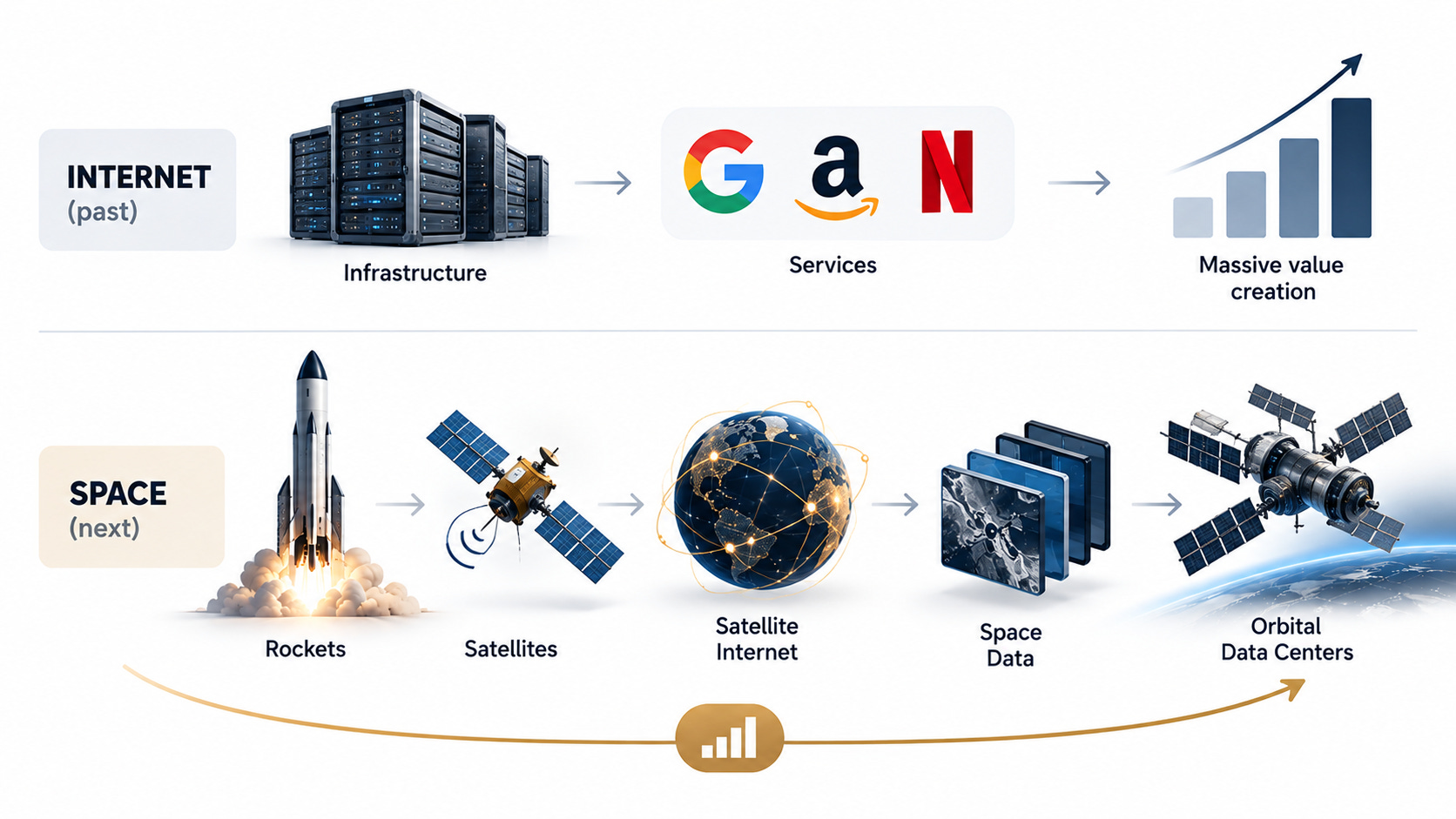
Space could follow a similar pattern:
Rockets: Provide access to space.
Satellites: Build communication and data networks.
Satellite Internet: Generate recurring revenue from global connectivity.
Space Data: Sell satellite imagery, intelligence, and analytics.
Orbital Data Centers: Potentially enable AI computing and data processing in space, although commercial viability remains unproven.
For investors, the distinction matters.
The companies generating recurring revenue from space infrastructure could ultimately capture more value than those launching rockets.
That’s why investing in the space economy requires looking beyond launch providers.
The $1.8 Trillion Space Opportunity
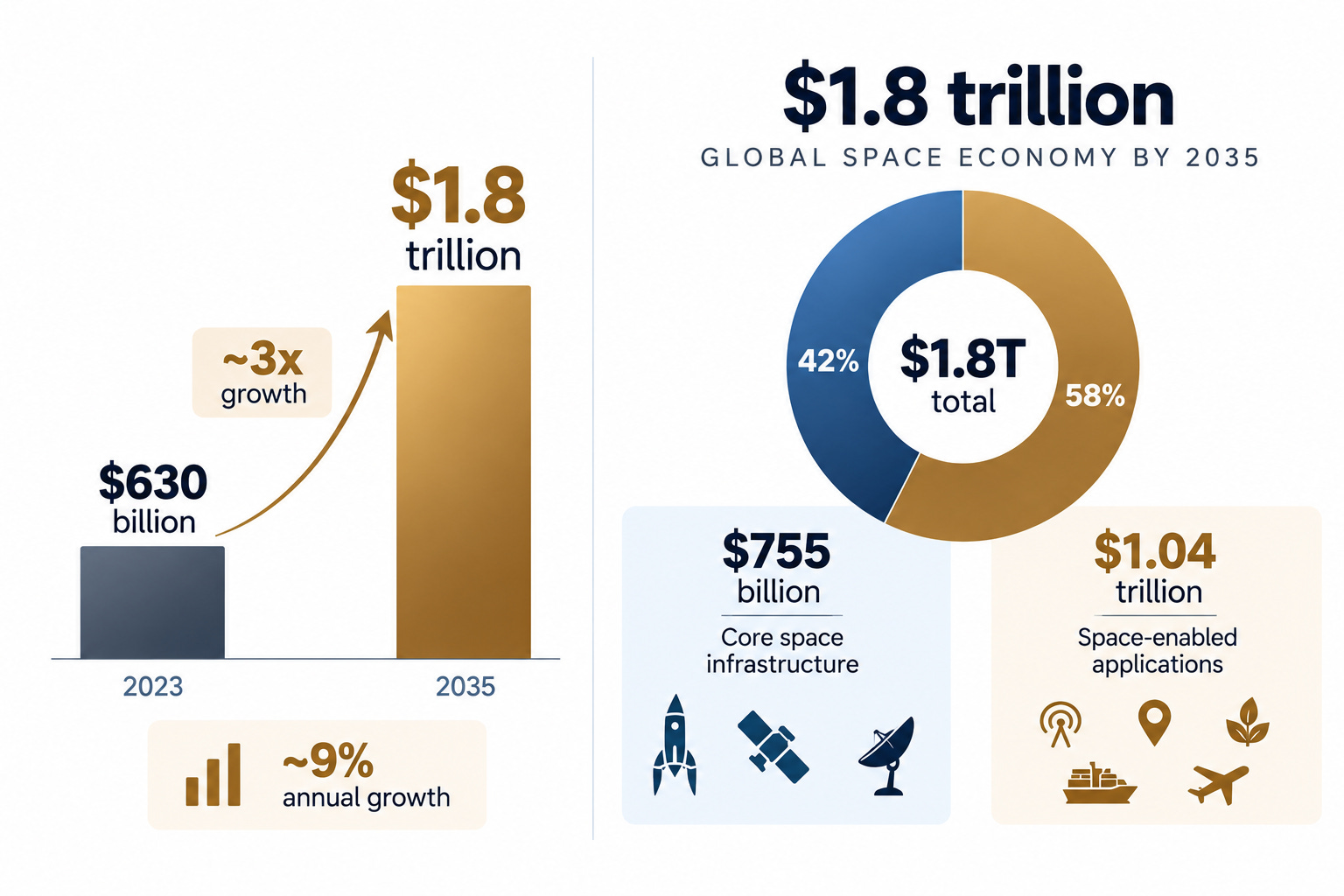
The World Economic Forum and McKinsey estimate the global space economy could grow from $630 billion in 2023 to $1.8 trillion by 2035.
That’s nearly 3x growth in 12 years.
Importantly, the $1.8 trillion includes economic activity enabled by space technologies, not just revenue earned by space companies.
For investors, the opportunity is identifying companies that can turn this growth into revenue, profits, and long-term shareholder returns.
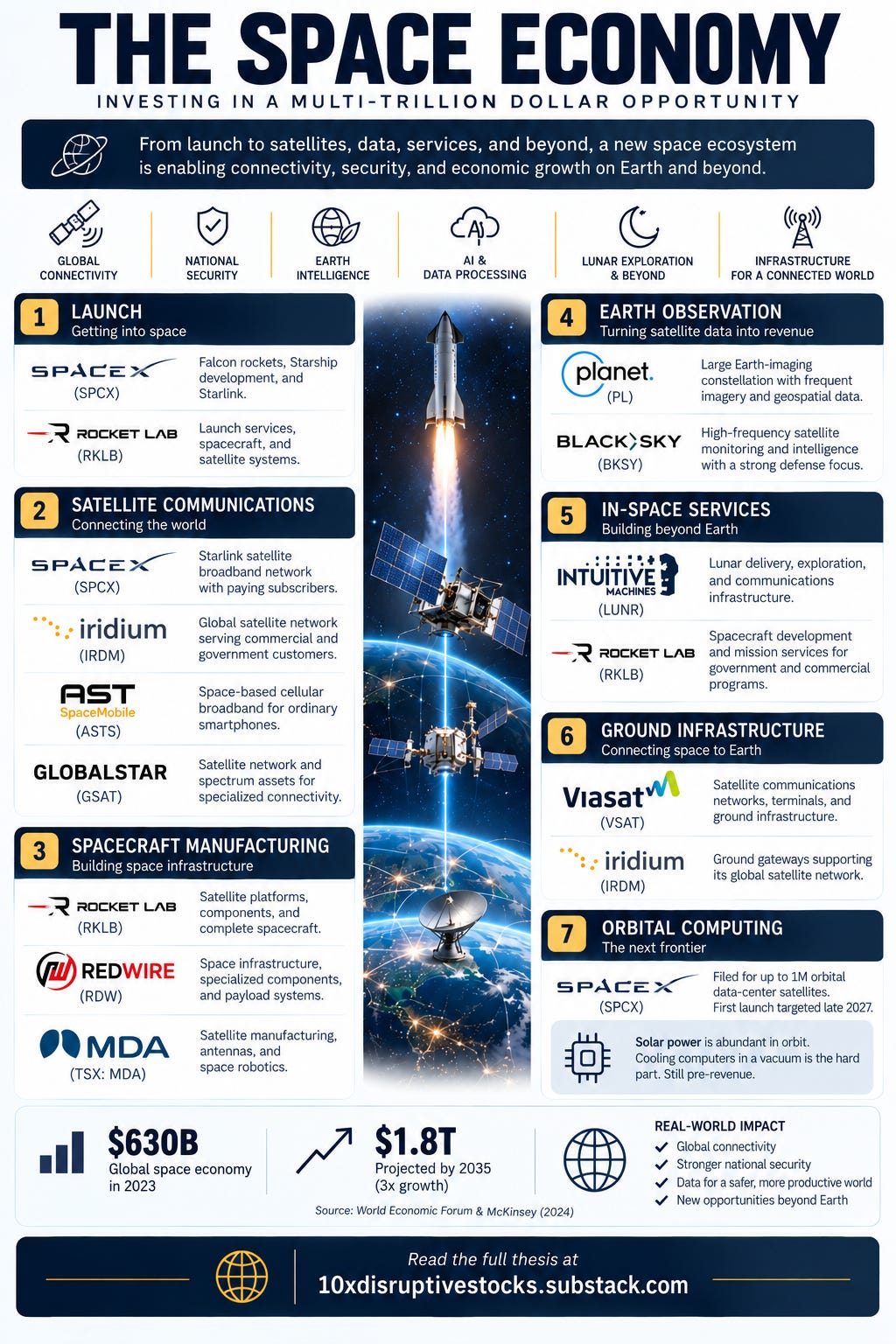
The Seven Layers of the Space Economy
Most people think investing in space means investing in rockets.
But rockets are only the beginning.
The space economy has seven major layers, each with a different way of making money.
1. Launch: Getting Into Space
Launch companies transport satellites, cargo, and equipment into orbit.
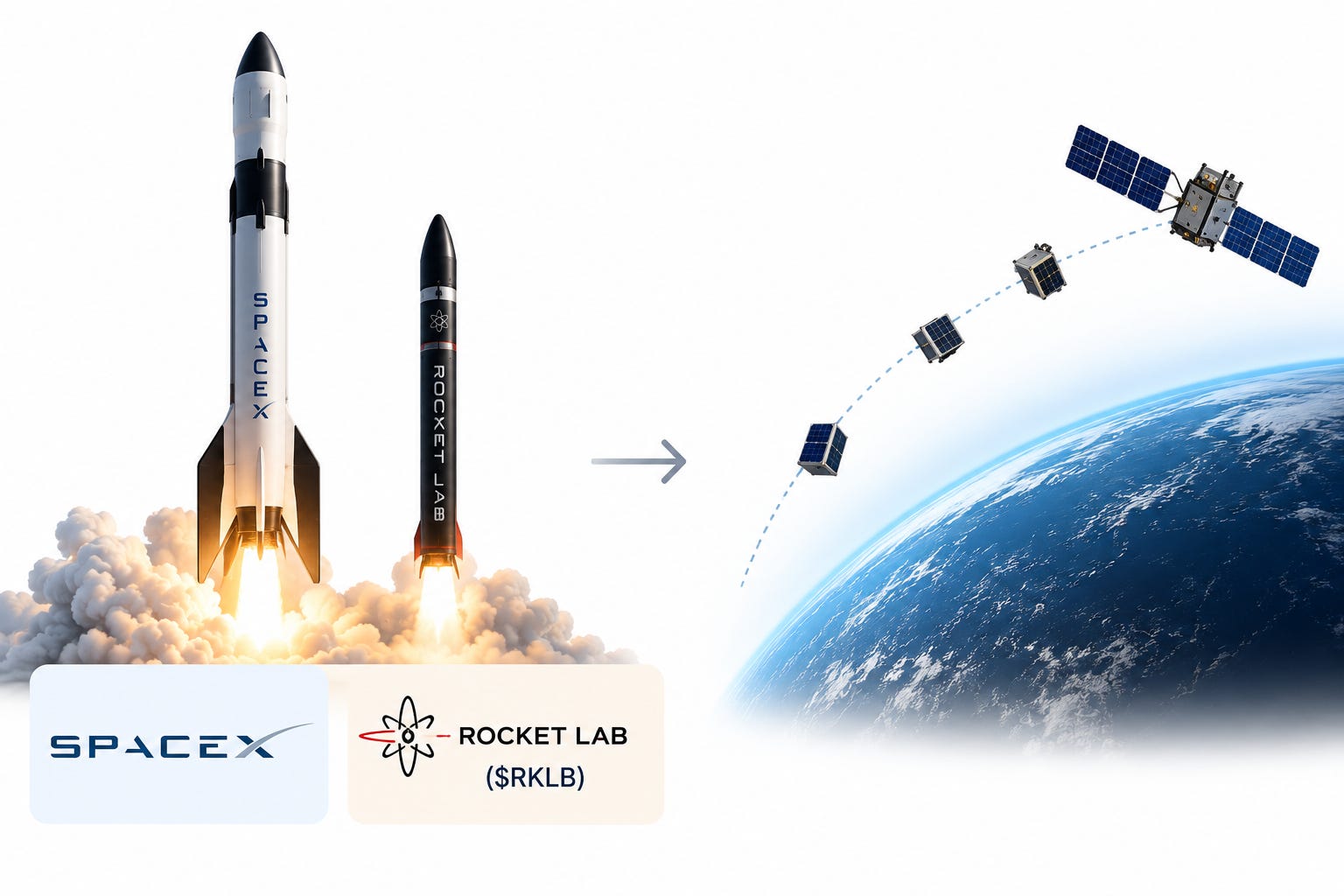
SpaceX has demonstrated reusable rocket boosters, helping reduce the cost of repeated launches.
Stocks to watch:
SpaceX | $SPCX: Falcon rockets, Starship development, and Starlink.
Rocket Lab | $RKLB : Launch services, spacecraft, and satellite systems.
How they make money: Launch contracts, spacecraft sales, and mission services.
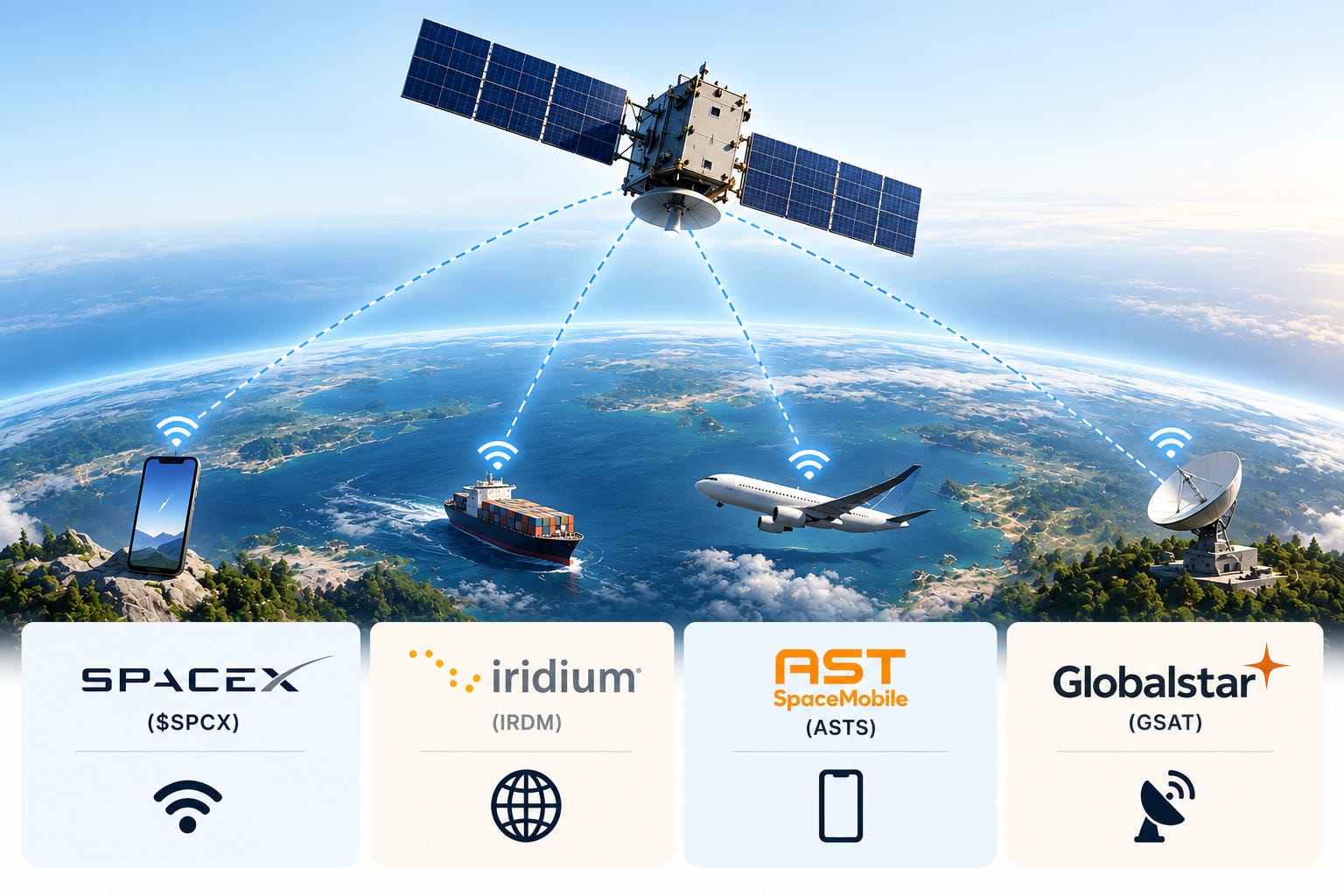
2. Satellite Communications: Connecting the World
Satellites provide internet and mobile connectivity where traditional networks are unavailable.
Direct-to-device technology is enabling compatible smartphones to communicate with satellites without specialized satellite phones.
Companies:
SpaceX ($SPCX): Starlink operates a large satellite broadband network with paying subscribers.
AST SpaceMobile ($ASTS): Developing space-based cellular broadband for ordinary smartphones.
Globalstar ($GSAT): Satellite network that powers the iPhone’s satellite features. Note: Amazon agreed to acquire it for about $11.6 billion, expected to close in 2027, so the stock now trades mostly on the deal price.
Iridium Communications ($IRDM): Established global satellite communications network serving commercial and government customers.
How they make money: Subscriptions, telecom partnerships, and network access fees.
3. Spacecraft Manufacturing: Building Space Infrastructure
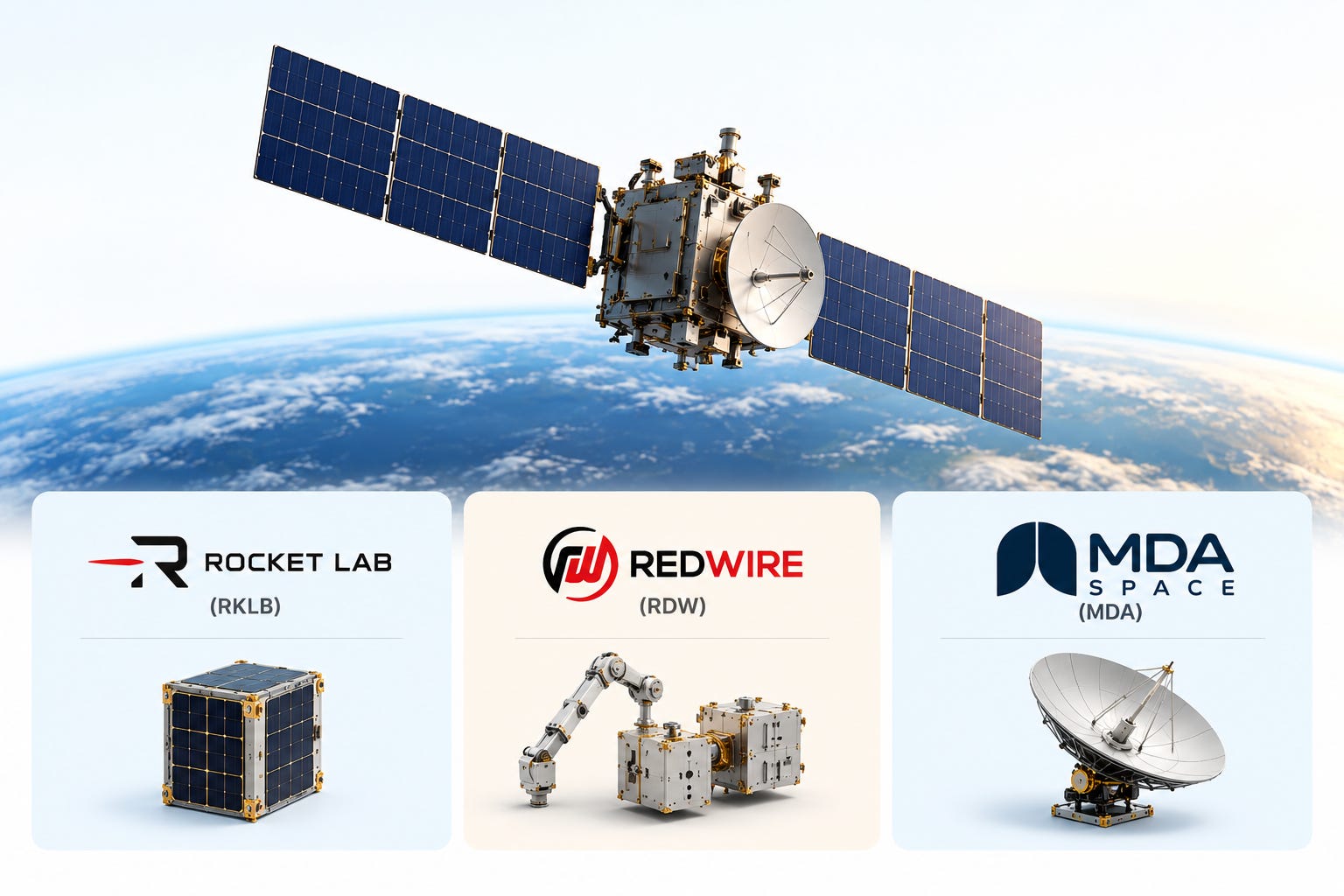
These companies manufacture satellites, spacecraft components, and equipment used in orbit.
Many low-Earth-orbit satellites have limited operating lifetimes, creating demand for replacement spacecraft.
Companies:
Rocket Lab ($RKLB): Satellite platforms, components, and complete spacecraft systems.
Redwire ($RDW): Space infrastructure, specialized components, and payload systems.
MDA Space ($MDA): Canadian satellite manufacturer, antennas, and space robotics. Listed in Toronto, so it may not be available in every US brokerage.
How they make money: Hardware sales, manufacturing contracts, and engineering services.
4. Earth Observation: Turning Satellite Data Into Revenue
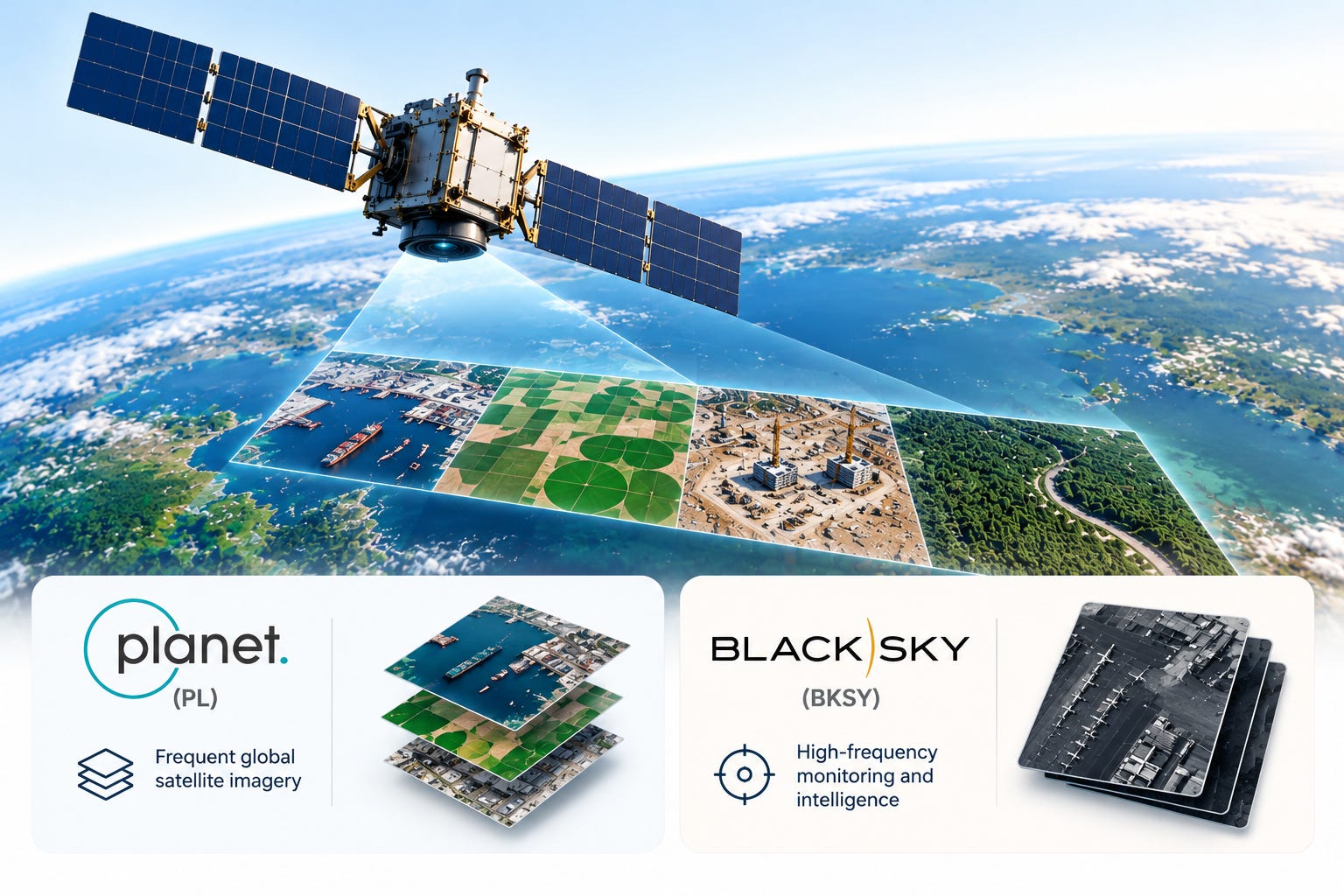
Satellites collect images and information used by governments and businesses.
Satellite imagery can monitor military activity, shipping traffic, crop health, and construction progress across the globe.
Companies:
Planet Labs ($PL): Large Earth-imaging constellation providing frequent imagery and geospatial data.
BlackSky Technology ($BKSY): High-frequency satellite monitoring and intelligence services, with a strong defense focus.
How they make money: Data subscriptions, imagery sales, and intelligence contracts.
5. In-Space Services: Building Beyond Earth
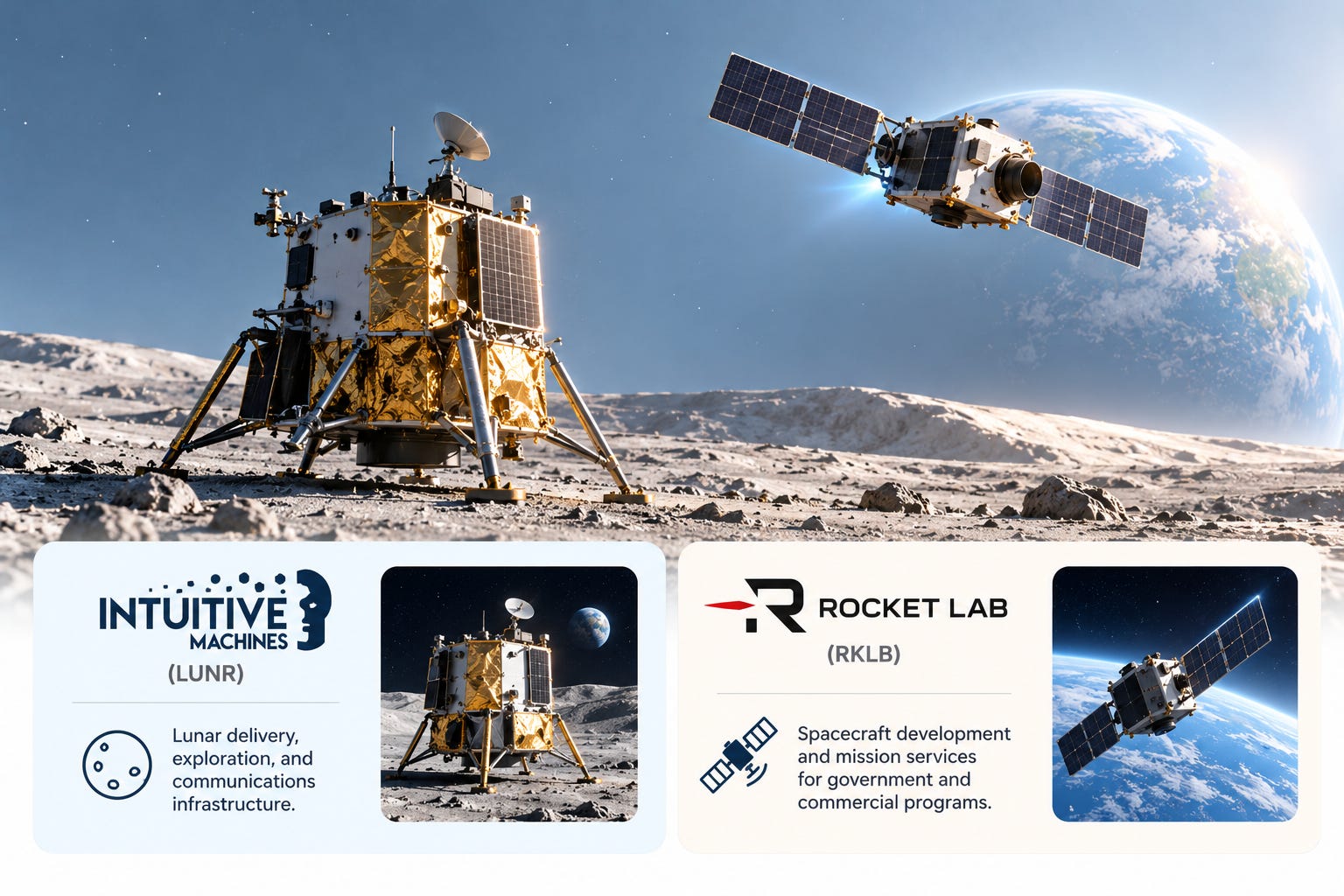
These companies develop technologies for lunar missions, orbital operations, and future space infrastructure.
NASA increasingly uses commercial companies to deliver payloads and services to the Moon.
Companies:
Intuitive Machines ($LUNR): Lunar delivery, exploration, and communications infrastructure.
Rocket Lab ($RKLB): Spacecraft development and mission services supporting government and commercial programs.
How they make money: Government contracts, mission services, and spacecraft operations.
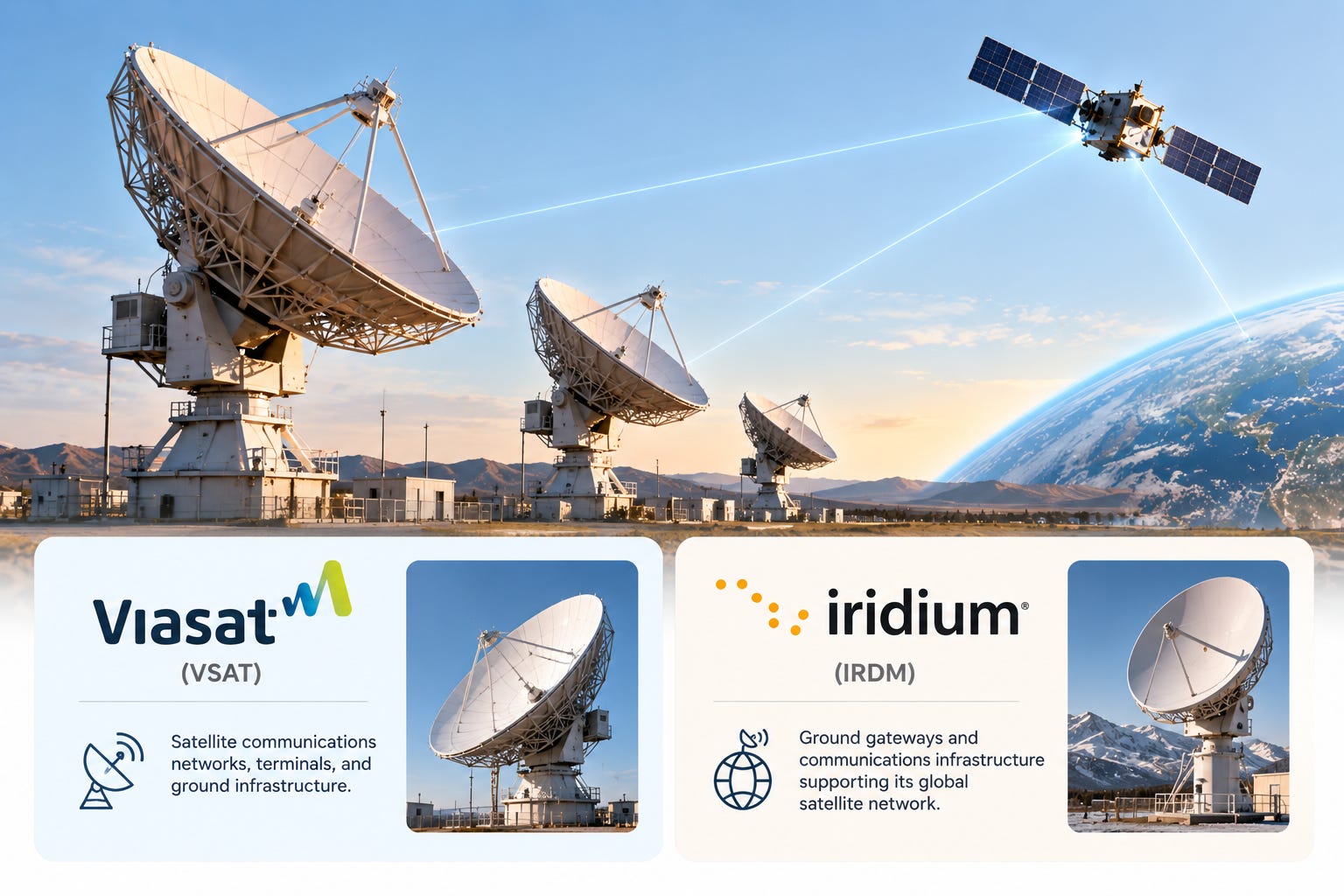
6. Ground Infrastructure: Connecting Space to Earth
Satellites require ground stations, antennas, and communications networks to transmit data.
Satellites depend on ground infrastructure to deliver much of their data and services to customers.
Companies:
Viasat ($VSAT): Satellite communications networks, terminals, and ground infrastructure.
Iridium Communications ($IRDM): Ground gateways and communications infrastructure supporting its global satellite network.
How they make money: Network services, equipment sales, and communications contracts.
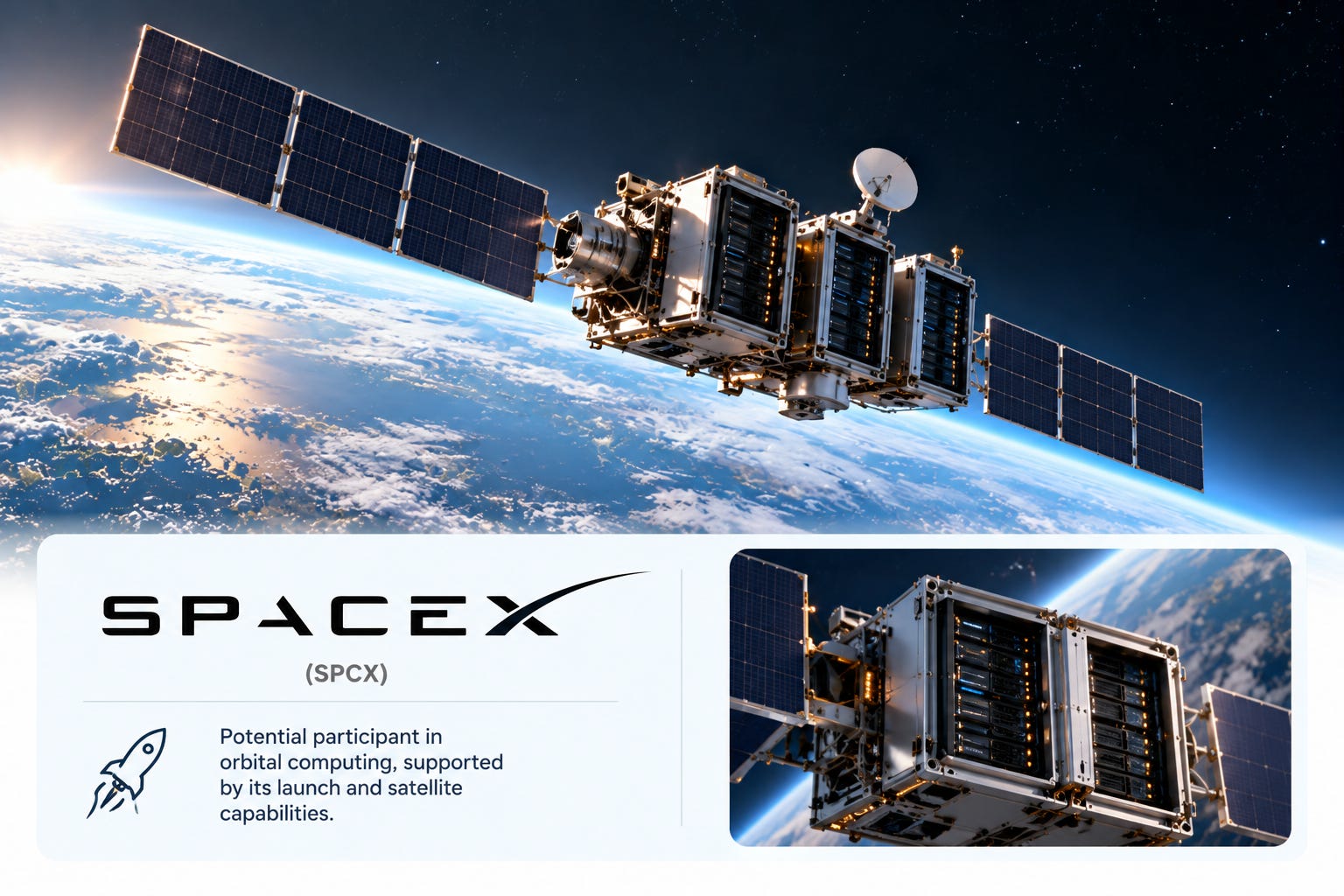
7. Orbital Computing: The Next Frontier
Companies are exploring data centers in orbit to process satellite information and potentially run AI workloads.
Solar energy is abundant in some orbits, but cooling high-performance computers in a vacuum is a major engineering challenge.
Companies to watch:
SpaceX ($SPCX): Filed to launch up to one million orbital data center satellites, with deployment possible as early as 2028.
Alphabet ($GOOGL): Launched the first test satellite for Project Suncatcher in October, carrying four of its own AI chips into orbit.
Emerging private companies: Startups like Nvidia-backed Starcloud, which has already run an AI model in orbit.
How they could make money: Computing capacity and data-processing services.
Space Ecosystem Visual Summary
The Space Stock Selloff: A Buying Opportunity?
Several space stocks have fallen over 60% from their highs, despite:
58%–90% revenue growth at several companies.
Record backlogs and new government contracts.
Growing demand for space infrastructure.
But not every beaten-down stock is a bargain.
I’ve identified 5 high-conviction stocks with attractive long-term potential, including my preferred entry prices and position sizes.